
Vehicle detectors are the “hidden heroes” of parking systems. They determine how reliably barriers open, how safely vehicles pass, and how smoothly traffic flows. But not every detector works well in every situation. Choosing the right technology depends on installation complexity, cost, reliability, and specific site conditions.
Here’s a breakdown of the three most common detector options:
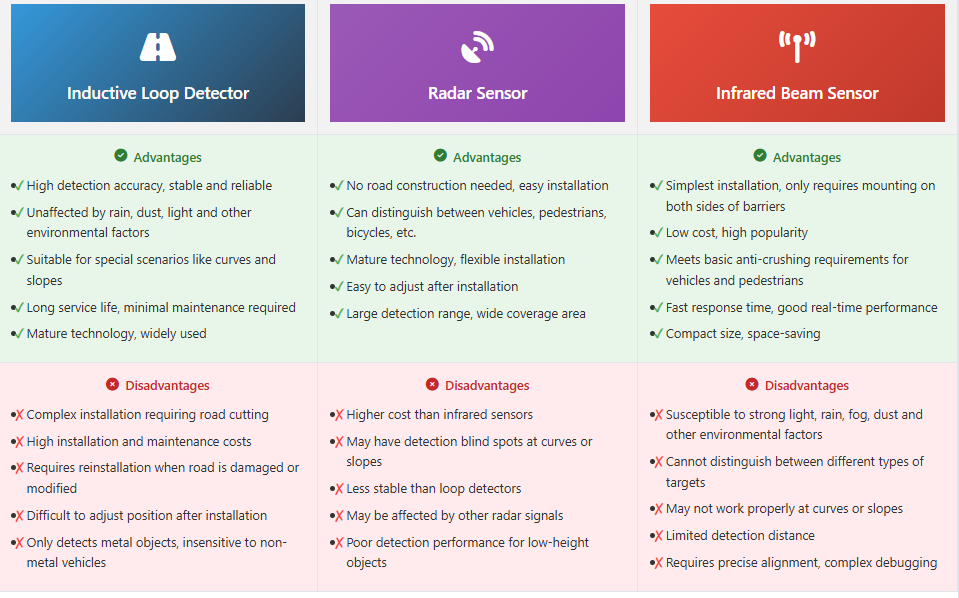
1. Inductive Loop Detectors
- Best for: Heavy-traffic lanes, ramps, or turning points.
- Pros: Highly reliable, unaffected by rain, dust, or light. The most stable solution in difficult locations like slopes or curved driveways where other detectors may fail.
- Cons: Requires cutting the road surface for installation. High labor and maintenance cost. Any road repair may require reinstalling the loop.
👉 Choose loop detectors when accuracy is critical and the site involves non-standard entry conditions.
2.Radar Sensors
- Best for: Standard entry/exit lanes, busy urban parking lots, and modern smart-parking systems.
- Pros: No roadwork required—easily installed on poles or barrier arms. Can differentiate between vehicles, pedestrians, and bicycles. Flexible positioning and easier maintenance.
- Cons: Higher initial cost compared to infrared. In ramps or turning lanes, blind spots may occur, making it less stable than loop detectors.
3. Infrared Beam Sensors
- Best for: Cost-sensitive projects, traditional parking systems, or where industry practice favors it (e.g., India and Southeast Asia).
- Pros: Lowest cost and easiest to install. Widely used, often as the standard safety feature to prevent barrier arms from hitting cars or pedestrians.
- Cons: Sensitive to strong light, rain, or dust. Cannot distinguish between different objects (a car vs. a person). Not suitable for slopes or turning points where the alignment of beams is difficult.
👉 Infrared is a simple and affordable choice for standard straight-lane car parks.
4. Key Takeaway
There is no single “best” vehicle detector—the right choice depends on your scenario:
- Curves or slopes? → Go with inductive loops.
- Need flexibility and advanced detection? → Radar is the solution.
- Budget-sensitive or standard layouts? → Infrared is often sufficient.
By matching technology to the site conditions, operators can achieve both cost efficiency and operational reliability.